Goodreads alternative for book tracking: LaterRex vs Goodreads
Which one you want depends on what else you track
Goodreads is the better choice if you want the largest book database in existence with the largest reading community attached to it, where every book already has reviews and your friends already have accounts. LaterRex is the better choice if books are one of several piles you are trying to keep on top of, because it puts your TBR in the same library as your movies, shows and games, and your Goodreads export lands with your star ratings, your reviews and the dates you actually finished things.
Let me be straight about something before we go further. If books are the only thing you track, this post probably ends with me pointing you somewhere else, and I am fine with that. LaterRex is not trying to be the best book tracker on the internet. It is trying to be the one place where your reading sits next to everything else you have on the go, which is a different job with a different answer.
Still, "Goodreads alternative" is one of the most searched things in this entire category, and nobody types it idly. They type it because they have been on Goodreads for eleven years, they have 800 books shelved, and opening it has quietly started to feel like admin.
What Goodreads is still better at
I do not want to undersell this part. Goodreads calls itself the world's largest site for readers and it is not a stretch: more than 150 million members as of 2023, and a rating on basically anything you can think to search for. Obscure translated fiction from 1974, a self-published LitRPG on book nine, your kid's set text. Somebody has rated it, and usually somebody has written four hundred words about why they hated the ending.
No newer app has that, and LaterRex does not have it either. There is no way to catch up on twenty years of people writing down what they thought.
The community side holds up too. Groups, buddy reads, the Choice Awards every December, and the Reading Challenge, which I still think nobody in this category has beaten. You pick a number of books for the year, and a small bar tells you that you are four behind. That is it. That is the whole thing, and it works on people. It has definitely worked on me.
Why people go looking anyway
The complaints have been the same for about a decade, which is sort of the point.
The interface is the first one. It still looks like a site built in 2007, because in the important ways it is one, and the pace of change since Amazon bought it in 2013 has been slow enough that readers notice. The recommendations are the second. Goodreads says they come from analysing 20 billion data points, and they still mostly hand you another edition of the book you just finished. And there are the small refusals that stack up, like half stars: Goodreads has been asked for years and has explained in its own help centre that it is not adding them, because of the complexity. A three-and-a-half-star book is a real thing that readers have opinions about, and being told the scale does not bend is a small irritation that never stops being irritating.
Then there is Amazon, which people feel differently about and I am not going to tell you how to feel. What matters practically is the bit underneath it: Goodreads retired its public API in December 2020, so nothing else can talk to your shelves any more. Every route out of Goodreads now starts with the same sentence, which is "download the CSV". That is not an accident, and it is why every app in this post, including mine, asks you for a file.
If you mostly read, look at StoryGraph and Hardcover first
This is the part where I would rather be honest than clever.
StoryGraph is the closest thing to a straight replacement. Nadia Odunayo started it in 2019, it is independent and pointedly not owned by Amazon, it passed five million signups in January 2026, and it does the things Goodreads will not: quarter stars, mood and pace filters, proper reading stats. Hardcover is the other one worth your time. Adam Fortuna and a small team have been building it since 2021, it is ad-free and built without outside money, it does half stars, it lets you set each book public or private, and they went and rebuilt the open API Amazon retired.
I should also tell you that LaterRex's book data comes from Hardcover's database. Every book you search for in LaterRex is matched against theirs. We love Hardcover and we keep working with them. We just want all our media in one place.
Where LaterRex fits
Here's the case we make:
Your reading does not happen in a sealed room. It happens on a Tuesday night, against the show you are three episodes into, the game your friend keeps going on about, and the podcast episode you saved a fortnight ago. Four apps, none of which know the others exist, and a decision you end up not making. Goodreads can speak for exactly one quarter of that evening, because it is a book site and it is very good at being a book site.
LaterRex holds all of it in one library. Same shelf, same search, same friends. And recommendations are the thing it is actually built around: when somebody tells you to read something, you save it right there with their name attached, and they get a nudge when you finish it, so they can ask you all about it the next time they see you. No feed, no scrolling, no performing your reading to strangers. Closer to a group chat about taste than a social network.
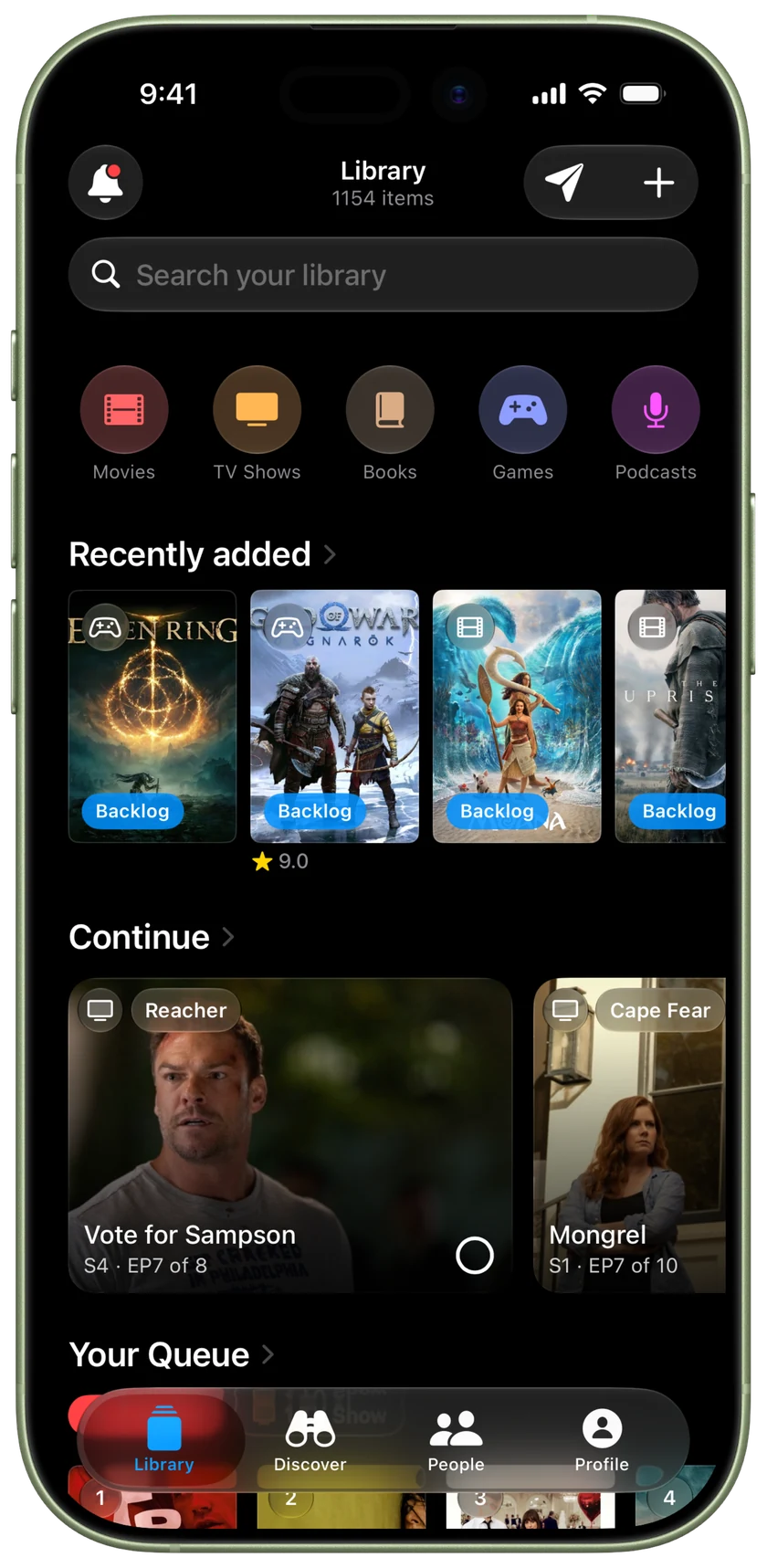
On the book side specifically, it goes further than you would expect from an app that also does games. Every read gets its own journal entry, rereads included, with a score out of 10, your own notes and a spoiler toggle, and you decide whether it stays private or goes out as a review. You keep your place in pages, percent or audiobook minutes, and there is a Currently Reading widget on your home screen so moving your bookmark is two taps. Editions carry their real page counts and run times. Series pages show you that you are on book three of nine and that book four is missing. Author pages show the whole bibliography with the ones you have read ticked off. You can track which format you own, and who you lent the hardcover to, which is the one thing books need that nothing else on your shelf does.
What it does not have is a Reading Challenge. There is no annual book target, no bar telling you that you are behind. Pages read and books finished are stats you can pin to your profile, but if that yearly number is the thing that keeps you reading, Goodreads still does it better and you should know that before you move.
What actually comes across from your Goodreads export
Since this is the thing everyone actually wants to know, here is the honest inventory.
You export the CSV from the Import and export page on the Goodreads desktop site (the mobile app cannot do it), and you hand that file to LaterRex. Every row gets matched by ISBN first, then by title, against Hardcover's database, so what lands is a real library with covers, authors and page counts rather than a plain list of titles. Your shelves come across into the books side of LaterRex like this: want-to-read becomes your Backlog, currently-reading stays as Reading, read lands as Finished, and a shelf you have named something like dnf or abandoned becomes Set Aside.
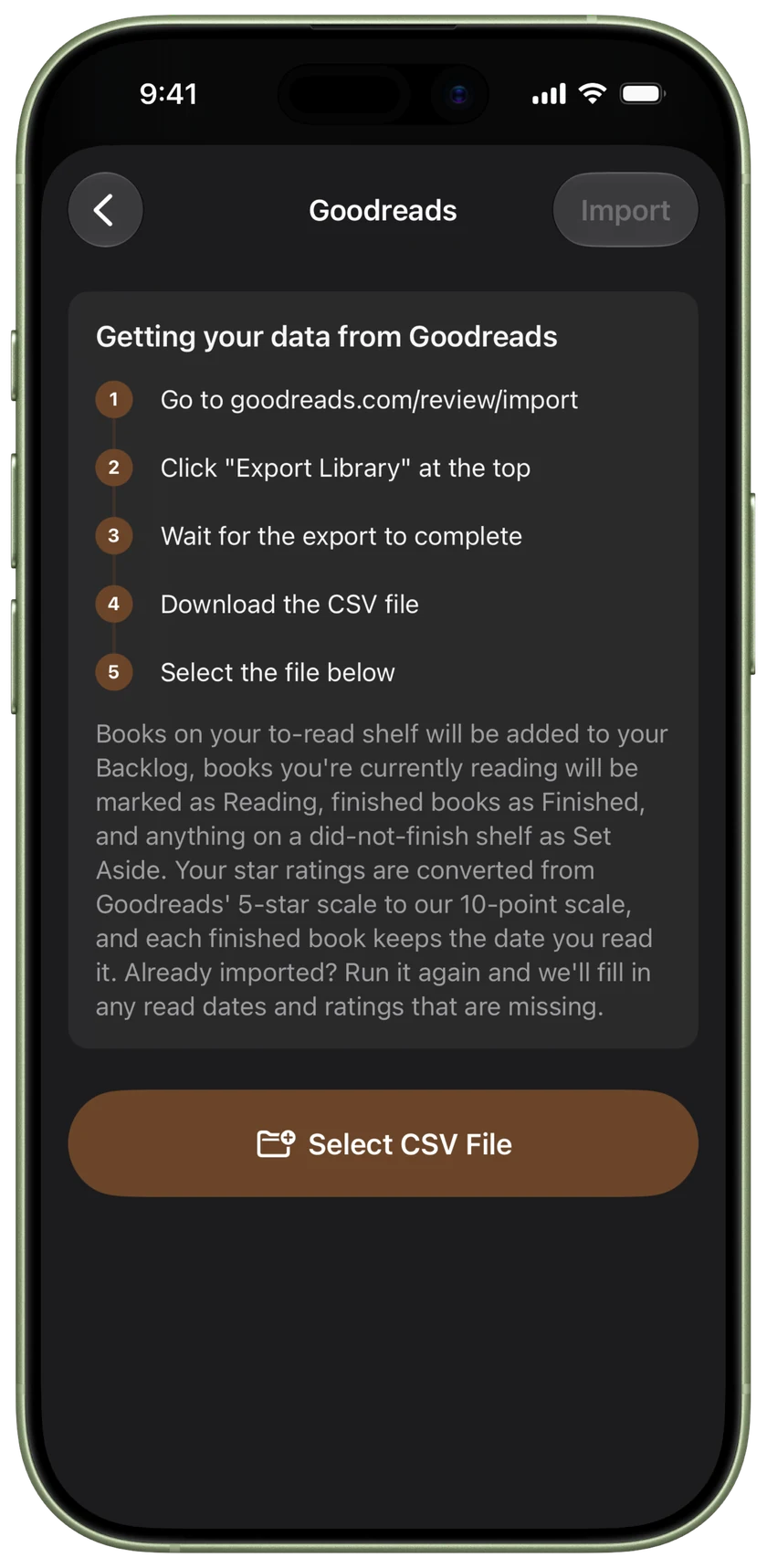
Your star ratings come across, converted from Goodreads' five stars to the ten-point scale LaterRex uses, so a four-star book arrives as an 8. Your read dates come across, which is the part I care about most, because a library that says you finished 300 books today is not your library. Where Goodreads has no Date Read for a finished book, LaterRex falls back to Date Added, marks that date as an estimate, and tells you on the results screen how many it had to guess at. Series bookkeeping in titles, the "(The Expanse, #2)" part, gets cleaned off on the way in. You see what matched and what did not before anything saves.
Your written reviews come across too, published as reviews the way they were on Goodreads, spoiler warnings included, and your private notes go into your journal where only you can see them. Custom shelves come across as lists, and you pick which ones (the free tier holds three). What does not come across is your reread history: the export only records one read date per book, so a book you have read three times arrives with that one read. The import is free, by the way. It is not behind the paid tier.
Goodreads vs LaterRex at a glance
| Goodreads | LaterRex | |
|---|---|---|
| Built for | Cataloguing your reading inside the biggest book community there is, and reading what everyone else thought. | Keeping your books in the same library as everything else you watch, play and hear, and trading picks with friends. |
| Media covered | Books and audiobooks. | Books and audiobooks, plus movies, TV, games, podcasts and music, and your own custom items. |
| Where it lives | The website, plus iOS and Android apps. | A native iOS app. Your library lives on your LaterRex account and also opens at app.laterrex.com. |
| Bringing your books in | Import and export both live on the desktop site, as a CSV. | Your Goodreads CSV, matched book by book, plus Letterboxd, IMDb, Trakt, TV Time, Steam and Apple Music for everything else. |
| Ratings and reviews | Whole stars only, written reviews, and a community average on every book. | Your own score out of 10 and a written entry per read, private or published, with rereads kept as separate entries. |
| Keeping your place | Update your page or percent and post a progress note. | Pages, percent or audiobook minutes, a Currently Reading home screen widget, and your place carries over if you switch edition. |
| The social side | Friends, followers, groups, public reviews and the Choice Awards. | Recommendations with the sender's name attached, a nudge when a friend finishes your pick, and no public feed. |
| Reading goals | The Reading Challenge: an annual target with a progress bar. | No annual challenge. Pages read and books finished are stats you can pin to your profile. |
| Finding the next book | Recommendations from 20 billion data points, plus lists, groups and the Choice Awards. | Hand-picked Discover collections, Trending, New Releases, series and author pages, and what your friends are reading. |
| Ads | Ad-supported. | None, on the free or the paid tier. |
| Price | Free. | Free, with an optional upgrade at $2.99 a month, $24.99 a year, or $99.99 once. |
Which one's for you
Stay on Goodreads if the reviews and the people are why you open it, and if the Reading Challenge is quietly the reason you finished nine books last year. Nothing else has that catalogue or that crowd, and swapping it for a nicer-looking app is a bad trade if the crowd was the point. If you are leaving because you want a better-built book app, go and look at StoryGraph and Hardcover, and take your CSV with you.
Worth saying the other half of that, though. A crowd of 150 million is part of why Goodreads stopped changing. LaterRex is at the opposite end: small, new, and still being built, and the people using it now are the ones shaping what gets added next. Ask for something and there is a decent chance you see it in the app a few weeks later. If you like getting in early on a thing and having a say in how it turns out, that counts for more than it sounds like it does.
Come to LaterRex if the problem is not really Goodreads at all. If it is that your reading is scattered across one app, your movies and shows across another, your games across a third, and the recommendation a friend gave you last month is gone because you never wrote it down. That is the pile LaterRex is built for, and books get the same care as everything else in it rather than a tick in a box. If you want the longer version of that argument, I wrote about tracking everything in one app when the app launched.
Frequently asked questions
Is LaterRex free?
Yes. The core app is free, including the whole Goodreads import. There is an optional upgrade at $2.99 a month, $24.99 a year or $99.99 as a one-off, which adds the stats charts, extra journal entries for rereads, unlimited lists and tags, and release notifications. The free version holds up on its own.
Can I import my Goodreads library into LaterRex?
Yes. Export the CSV from the Import and export page on the Goodreads desktop site, then hand it to LaterRex in Settings. Every book is matched against Hardcover's database, so you get real covers, authors and page counts, and your shelves, star ratings, reviews and read dates come across with them.
What does not come across in the import?
Your reread history is the main thing. The Goodreads export records a single read date per book, so a book you have read three times arrives with one read. Your reviews, private notes and custom shelves all come across now, though keeping your CSV somewhere safe after the import finishes is still a good habit.
Which should I pick if books are all I track?
Honestly, probably StoryGraph or Hardcover, which are both excellent and both built for readers first. LaterRex earns its place the day your shows, games and podcasts need to live somewhere too, and that is when the books side of LaterRex starts making more sense than a dedicated reading app.